

How Many Cigarettes in a Pack? Standard Counts Cartons and Packaging Facts
In the United States a standard pack of cigarettes holds 20 cigarettes. That has been true for decades and it is still true today.
But the number is not arbitrary. For consumers it sets expectations. For retailers it determines shelf space and pricing. For packaging manufacturers it is the foundational spec that everything else gets built around. Box dimensions carton structure material weight warning label placement, all of it starts with that one number.
This guide covers what the standard pack count is globally how cartons are structured and why the packaging industry has not moved away from 20.
How Many Cigarettes Are in a Pack
The standard number of cigarettes in a pack is 20. That is the answer whether someone is asking as a consumer a retailer or a packaging buyer. It is the most widely used format across the industry and the one that virtually every major brand produces as their core SKU.
Not every pack is identical though. The count is consistent but the format is not. A 20 count hard box and a 20 count soft pack hold the same number of cigarettes but they are physically different products with different material specs and different production requirements.
Some markets also sell packs with different counts. Ten cigarette packs exist in regions where regulations limit pack size or where affordability pricing drives lower per transaction volume. Twenty five and 30 count packs appear in specific countries. Slim format packs serve a niche segment. None of those variations come close to threatening the dominance of 20. The supply chain was built around it and that is a hard thing to undo.
How Many Cigarettes Come in a Pack Around the World
The 20 count is a global baseline but it is not a universal requirement. Different markets have landed in different places.
United States
In the US a pack of cigarettes contains 20 cigarettes by strong industry convention. There is no federal law mandating the count but every major brand sells 20s as their standard. Ten count packs are not common here. Consumers expect 20 and packaging is produced accordingly.
Canada and Europe
Canada moved to a minimum of 20 cigarettes per pack through federal regulation specifically to prevent cheap small packs from being marketed to younger buyers. Many European countries follow similar minimums. Some European markets also permit 19 count packs in specific contexts though 20 remains the norm in production and retail.
Australia and Other Markets
Australia standardized on 20 count packs and moved to plain packaging laws that removed brand design entirely. Some Asian and South American markets still offer 10 count and 14 count packs alongside 20s. The variation tends to follow the tax structure. Where per stick taxes are high smaller packs make entry price lower for consumers.
| Packaging Unit | Standard Count |
| US Standard Pack | 20 cigarettes |
| Canadian Standard Pack | 20 cigarettes (minimum) |
| European Standard Pack | 20 cigarettes |
| Australian Standard Pack | 20 cigarettes |
| Some Asian and South American Markets | 10, 14 or 20 cigarettes |
How Many Packs of Cigarettes Are in a Carton
A standard carton contains 10 packs. One carton equals 200 cigarettes. That structure has not changed in decades and there is no serious movement to change it.
Cartons exist to make wholesale and retail distribution manageable. Moving individual packs through a distribution chain at volume would create serious inventory tracking problems. Ten packs sealed in a carton makes counting faster at the receiving dock easier to stock on the retail side and simpler to track through the chain. The number is not interesting. The utility of it is.
Retailers order by the carton. Distributors ship by the carton. The math stays consistent at every level and that consistency is the point.
Why Packaging Companies Use 20 Cigarette Packs as the Standard
The honest answer is infrastructure inertia. But there are legitimate practical reasons the format held.
Easier Retail Display
A 20 count pack fits standard retail display racks without wasted space. The dimensions are narrow enough to fit multiple facings on a shelf and deep enough to stack without tipping. Retailers designed their fixtures around this size. Changing the count would mean changing the box and changing the box would mean reconfiguring display systems across hundreds of thousands of retail locations.
Better Shipping Efficiency
Ten 20 count packs fill a carton cleanly. Cartons stack into shipping cases at predictable ratios. Case weights are consistent which matters for freight calculations. A different count throws off every ratio in the chain and the adjustment cost is not trivial.
Consistent Box Dimensions
Tooling for cigarette box production is built around specific dimensions. The 20 count format has driven those dimensions for so long that manufacturing equipment worldwide is calibrated to it. New molds new tooling and new carton dies are expensive. No brand has had a compelling enough reason to absorb that cost.
Consumer Convenience
Twenty cigarettes fits a shirt pocket without bulk. The pack is easy to open and reseal. Consumers have been using this format long enough that it feels correct even to people who have never thought about why. That familiarity is its own form of lock in.
Common Types of Cigarette Packaging
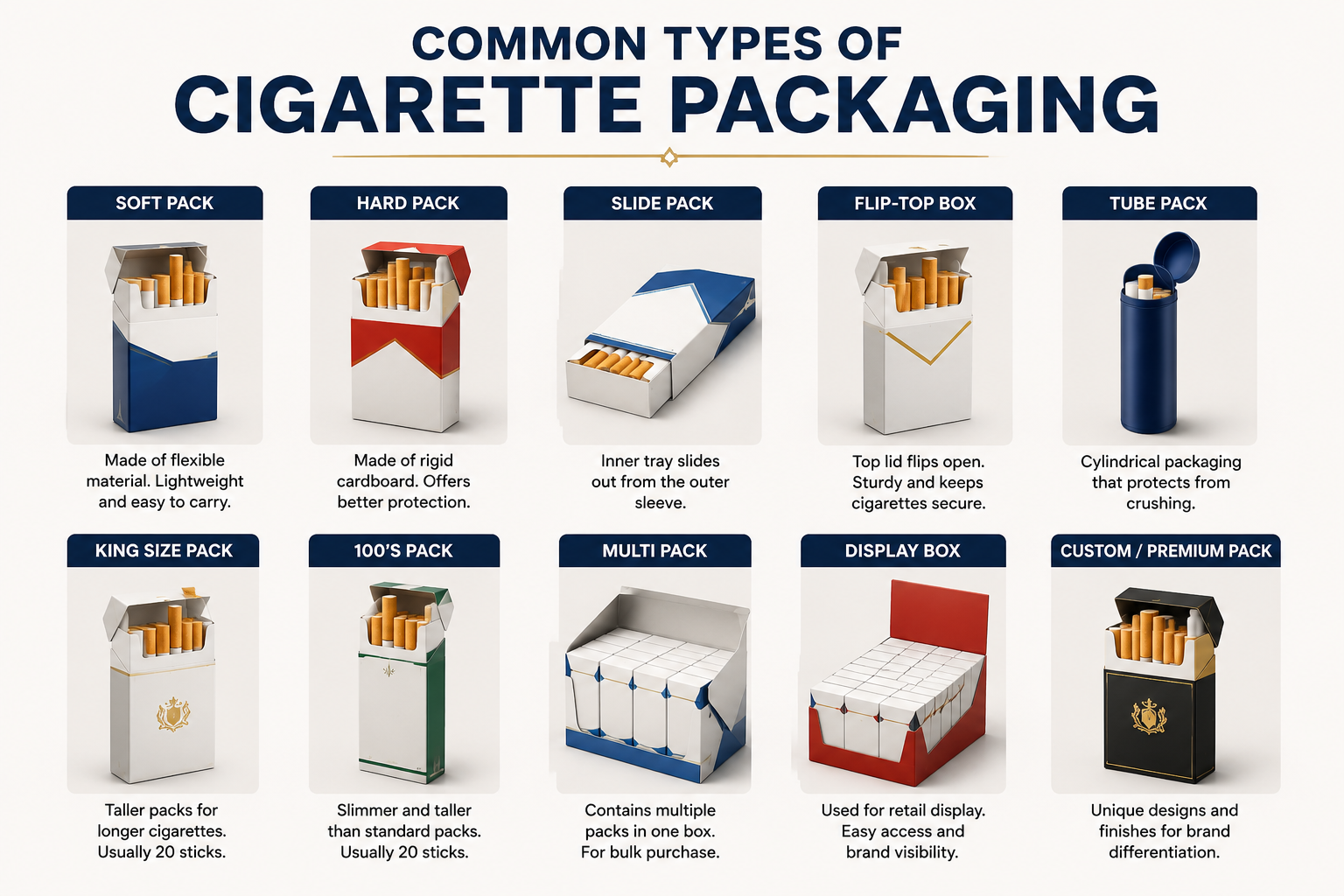
The count is usually the same. The package is not.
Hard Packs
The rigid flip top box is the most common cigarette package format in the US. It protects cigarettes from crushing and holds its shape in a pocket or bag. The box is scored and folded from a single printed sheet then glued at specific seams. Hard packs require more material per unit than soft packs but they offer better product protection and a larger surface for branding.
Soft Packs
Soft packs use a foil inner wrap and a thin outer paper sleeve. They are lighter and cheaper to produce than hard boxes. The format is more common in price sensitive markets and among older smokers who grew up with it. Soft packs do not protect cigarettes from crushing as well but the lower production cost makes them viable in certain segments.
Slide and Shell Boxes
The slide and shell format uses an inner tray that slides out of an outer sleeve. It is a premium format used by brands that want a more tactile upscale opening experience. Production is more complex and material cost is higher but the format creates shelf differentiation. Does packaging style affect cigarette count? No. Hard packs soft packs and slide and shell boxes all hold the same number of cigarettes. The count is set by the brand and market. The packaging format is a separate decision entirely.
How Pack Size Impacts Cigarette Box Design
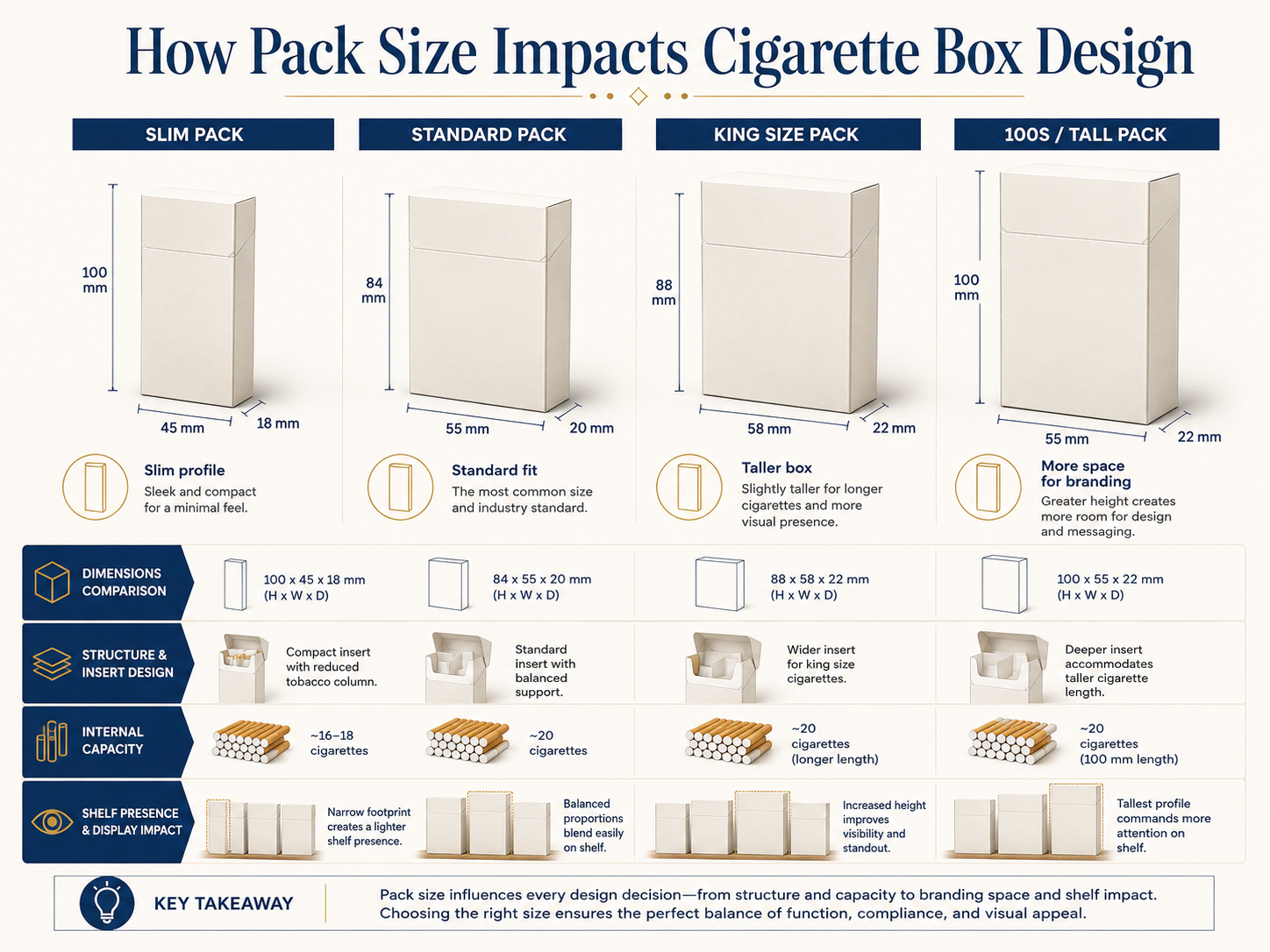
Pack size is not a design preference. It is the starting constraint that everything else is calculated from.
The number of cigarettes inside determines the interior dimensions of the box. Interior dimensions set the exterior wall thickness requirements. Exterior dimensions determine how the pack sits in a carton and how many cartons fit in a shipping case. Warning label placement depends on available surface area which is a direct function of box size. Branding space on the front panel is what is left after regulatory requirements are met.
Because the pack count determines the internal space, packaging teams must calculate the length, width and height of the box before finalising its dieline, warning panels and carton arrangement.
A 2 millimeter change in pack width creates a cascade. Tooling needs adjustment. Carton die lines shift. Case count per pallet changes. Freight weight recalculates. Packaging teams do not treat size as something that can be tweaked casually. It is the first number locked and the last one anyone wants to reopen.
Quick Facts About Packs and Cartons
| Packaging Unit | Quantity |
| Pack of Cigarettes | 20 Cigarettes |
| Half Pack | 10 Cigarettes |
| Carton | 10 Packs |
| Standard Carton Total | 200 Cigarettes |
Summary
Twenty cigarettes per pack. Ten packs per carton. Two hundred total per carton. The system is straightforward and it has been stable long enough that the entire industry supply chain runs on it without thinking about it.
For packaging manufacturers that stability is useful. The specs are known the tooling exists and the distribution math is already solved. The real work is in execution not in reinventing the format.
FAQs
How many cigarettes come in a pack in the USA?
Twenty. Every major US brand produces 20 count packs as their standard. Ten count packs are not a common retail format in the US market.
How many packs of cigarettes are in a carton?
Ten packs. A standard carton holds 200 cigarettes total. That structure is consistent across virtually all markets that use carton packaging.
Can a pack contain more than 20 cigarettes?
Yes in certain markets. Twenty five and 30 count packs exist in specific countries usually shaped by local tax structures. They are not available in the US as a standard retail format.
Do hard packs and soft packs hold the same number of cigarettes?
Yes. The packaging format does not change the count. Hard boxes soft packs and slide and shell packaging all hold whatever number the brand specifies for that market. In the US that is almost always 20.
Why is 20 cigarettes per pack the standard?
Infrastructure built around it over decades. Manufacturing equipment retail fixtures distribution ratios and consumer expectations all reinforced the same count until changing it became more expensive than maintaining it. The format is not perfect. It is just deeply embedded.
Does cigarette size change the pack count?
No. King size 100s and slim cigarettes all come in standard 20 count packs in the US. The physical length or diameter of the cigarette changes. The number per pack does not.