
Business Card Size Guide: Standard Dimensions, Bleed and Design Tips
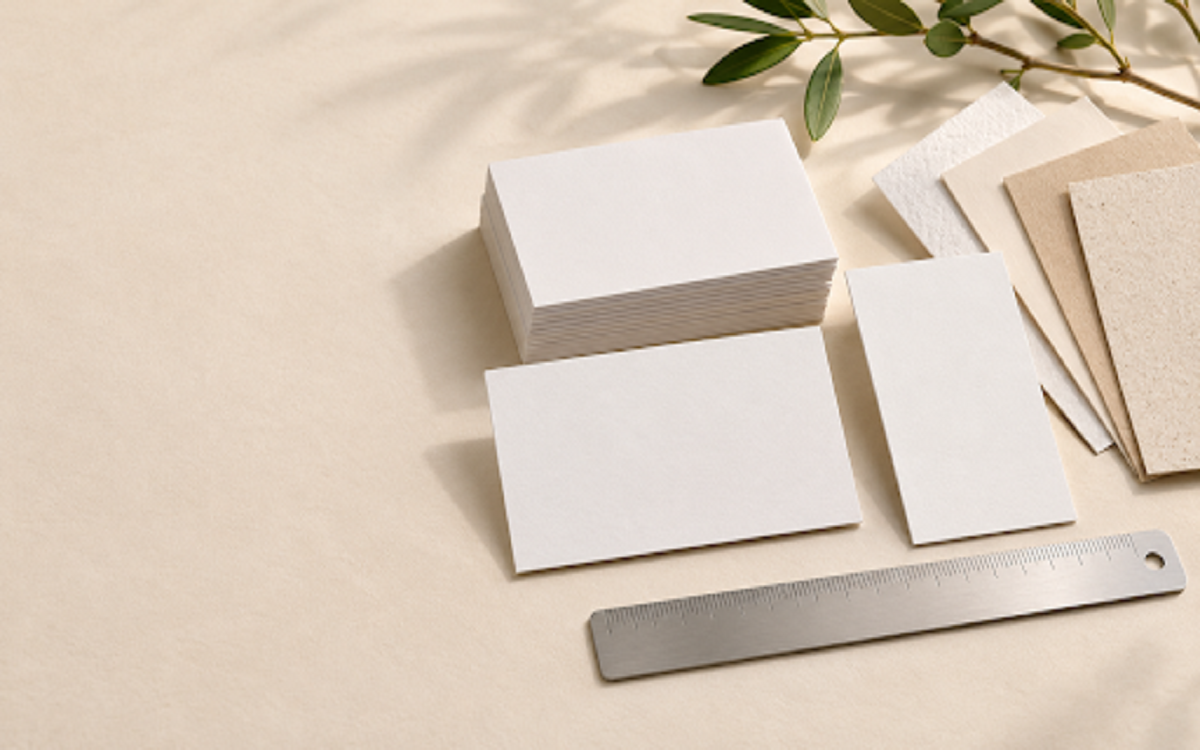
A business card that is the wrong size looks wrong before anyone reads a single word on it. Edges get trimmed too close, text sits crooked in a cardholder or the card simply does not slide into a wallet the way every other card in there does. The standard UK business card size is 85 by 55 millimetres. Everything else in card design, the bleed, the safe area, the finish, builds outward from that one number.
At Art Impact Packaging, card sizing gets the same attention we give any print job, whether that is a run of corrugated boxes for shipping or a batch of custom burger boxes for a takeaway counter. A burger box and a business card are built from different stock entirely but the sizing logic, get the dimensions right first, is exactly the same.
What Is the Standard Business Card Size?
So how large is a business card, exactly? In the UK, 85 by 55 millimetres is the size printers default to unless told otherwise. The business card size in inches works out to roughly 3.35 by 2.17. Neither number is arbitrary. Wallets, cardholders and card scanners were all built around a size close to a standard credit card and 85 by 55 mm sits right in that range. The average business card size has barely moved in decades for exactly that reason. Order a size wildly outside it and the card will look fine on a screen and awkward in a pocket.
Business Card Sizes in Different Countries
The UK standard is not universal. A card designed for one market can look slightly off in another and the difference is easy to miss until the cards are already printed.
| Region | Standard Size | Notes |
| UK and Europe | 85 x 55 mm | The default size at almost every UK print shop |
| USA and Canada | 3.5 x 2 inches | Roughly 89 x 51 mm, close but not identical to the UK size |
| Australia and New Zealand | 90 x 55 mm | Slightly wider than the UK standard |
The gap between the US and UK sizes is small on paper. A couple of millimetres. It shows up anyway once a card sits next to others in a holder built for one size or the other.
Business Card Dimensions for Print and Digital Design
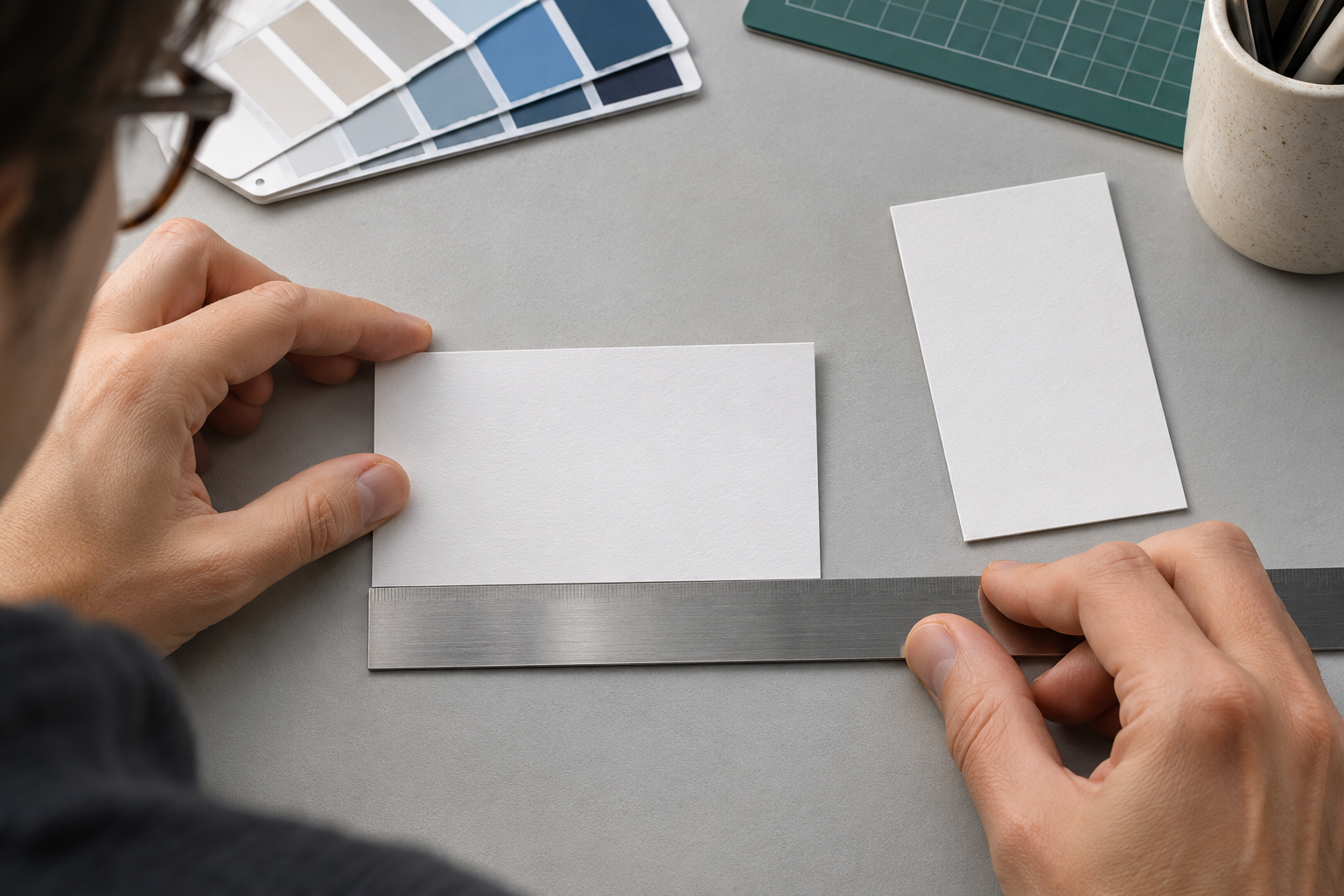
Print software wants millimetres or inches. Screens and design tools built around pixels want a DPI conversion. Both need to point at the same physical card.
| Unit | Portrait | Landscape |
| Millimetres | 55 x 85 mm | 85 x 55 mm |
| Inches | 2.17 x 3.35 in | 3.35 x 2.17 in |
| Pixels at 300 DPI | 650 x 1004 px | 1004 x 650 px |
Orientation is a design choice, not a technical one. Landscape suits most logos and long job titles. Portrait suits a card built around a strong vertical image or a minimal, centred layout. Anyone who already blocks out box dimensions using this guide to measuring length, width and height will recognise the same length-by-width thinking here, just at a much smaller scale. The same applies to anyone mocking up packaging in a 3D tool like Pacdora, where getting the flat dimensions right always comes before the fold lines and the artwork.
Bleed, Trim and Safe Area Explained
Bleed is the part of the design that gets cut off on purpose. A 3 millimetre bleed on every side is the standard which pushes the final artwork size to 91 by 61 mm before trimming. Background colours, patterns and full-bleed images should extend into that zone. Nothing else should.
Logos, text and contact details need to stay inside the safe area, comfortably clear of the trim line. Printing is not a precision science down to the millimetre. Cutters drift slightly from sheet to sheet and a phone number sitting right on the trim edge can end up sliced in half on some cards in the batch and fine on others. Keep anything that matters at least a few millimetres inside the edge and that problem disappears entirely.
Alternative Business Card Shapes and Sizes
Standard size is standard for a reason but it is not the only option. Square cards trade the wallet-friendly shape for a bolder, more distinctive look on a desk or in a display stand. Mini cards go smaller still, often used for a secondary contact card or a loyalty-style card and cost less to print at volume. Folded cards double the surface area without changing the footprint, useful for a card that needs a bit more room for a map, a menu or a longer message. The idea works the same way a tuck box does: extra panels, same footprint on a shelf.
Rounded corners and fully custom die-cut shapes push furthest from the standard, cutting a logo shape or an unusual silhouette directly into the card stock. Tulip boxes solve a similar design problem in packaging, an unusual shape that still needs to hold its structure. Techbullion covered the sizing and design tradeoffs on custom tulip boxes in detail and the same piece was picked up separately by BigNewsNetwork. The core lesson carries over directly to cards: an unusual shape gets noticed but only if it still works.
That is the whole appeal of an unusual size and also the tradeoff. A card that does not match the shape of a wallet slot or a standard holder gets left on a desk more often than it gets carried around and a memorable shape only helps if the card survives long enough to be looked at twice.
Choosing the Right Card Thickness and Finish
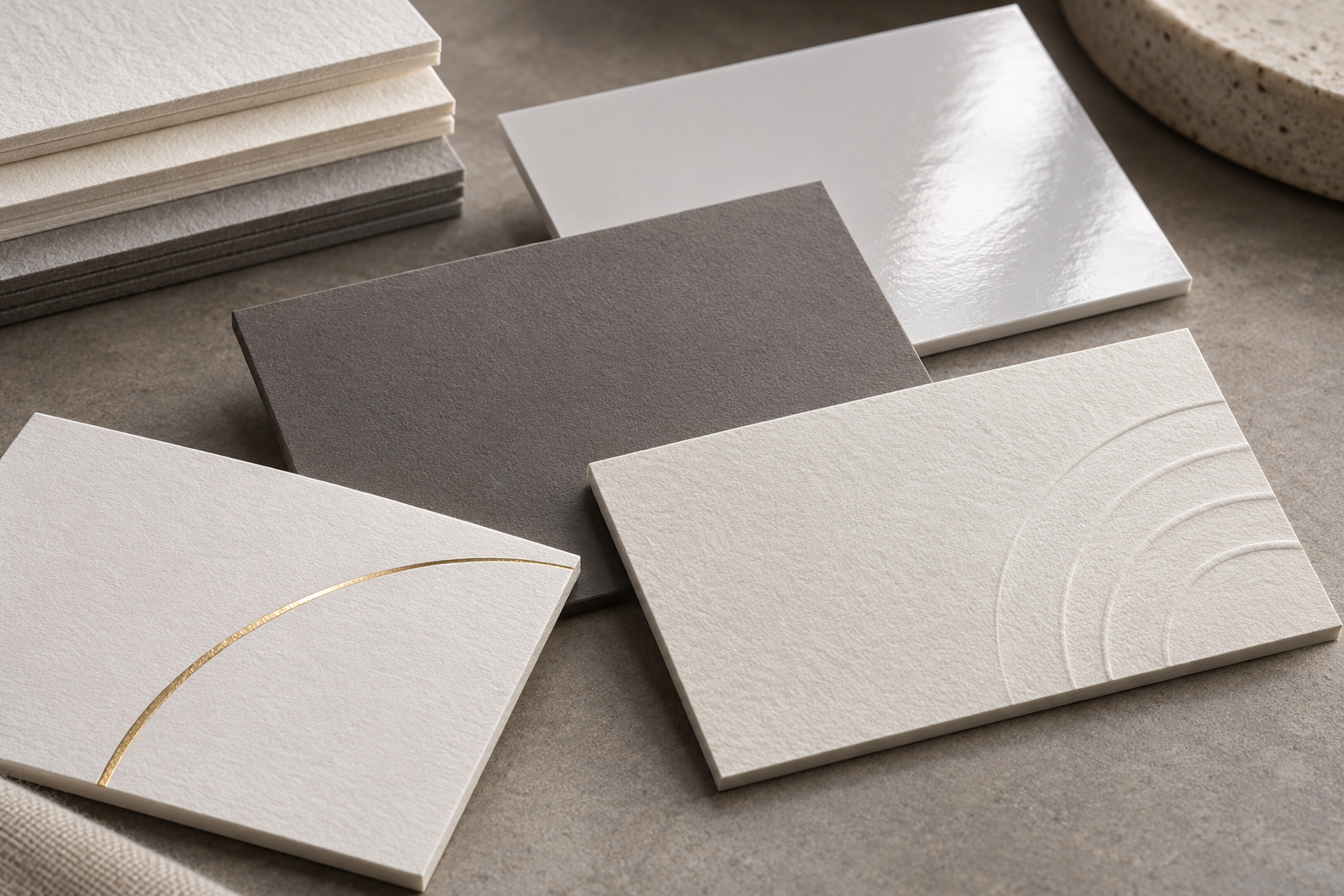
Thickness and finish do more for how a card feels than most people expect and feel is most of what a business card actually communicates in the first three seconds someone holds it. Standard card stock, usually around 350 gsm covers most everyday needs at a reasonable cost. Premium stock adds noticeable weight and rigidity, closer to 400 to 500 gsm and reads as more considered without shouting about it.
Luxury stock goes further still, thick enough that it changes how the card sounds when it is set down on a table, closer in feel to the structure of a rigid box than a flimsy flyer. That same weigh-up between a lightweight option and something sturdier shows up again in the comparison between mailer boxes and rigid boxes: lighter travels cheaper, sturdier survives handling and makes a stronger impression.
Finish carries its own message. Matte reads calm and modern and resists fingerprints better than most people realise, which is why so many cosmetic boxes lean on the same soft-touch coating. Gloss makes colour and photography pop but shows smudges fast. Soft touch sits between the two, a slightly textured coating that feels almost like fabric under a thumb, similar to the uncoated, natural finish on kraft boxes.
Foiling, embossing and spot UV are finishing touches rather than base finishes, small raised or reflective details on a logo or a name that catch light differently depending on the angle a card is held at. The same techniques show up on magnetic closure boxes, where a foiled logo on the lid does the same job a foiled name does on a card. For a closer look at two of those techniques specifically, this breakdown of emboss versus deboss covers which one suits which kind of logo and this comparison of rigid boxes against magnetic closure boxes walks through a similar structure-versus-finish decision at box scale.
None of these choices exist in isolation. A minimalist tech brand and a hand-crafted pottery studio should not land on the same card stock, even if both cards are the exact same size.
Common Business Card Design Mistakes to Avoid
The size mistake is the most common one and it is entirely avoidable. Designing at the wrong dimensions then scaling the file up or down at the last minute, distorts every measurement on the card including the ones that were fine to begin with. Close behind it is ignoring bleed and safe area, which is how logos end up clipped and phone numbers end up cut in half on a portion of a print run.
Cramming too much information onto a card that measures 85 by 55 mm is its own kind of mistake. A card is not a brochure. Name, role, one phone number, one email, maybe a website. That is usually the ceiling, not the floor. Low-resolution logos and images cause a different problem entirely, one that only shows up after printing, when a crisp screen image turns fuzzy and pixelated at print size. And a font chosen because it looked interesting in a mockup can become genuinely hard to read at business card scale, especially in a size eight or nine point contact line squeezed into a corner.
Final Thoughts
Start from 85 by 55 mm unless there is a specific reason not to. Build in the 3 millimetre bleed, respect the safe area and pick a card stock and finish that actually match the brand rather than whatever the print shop defaults to. It is the same principle that guides every product on theArt Impact Packaging site whether that is a set ofcosmetic boxes for a skincare launch or the cards a founder hands out at the trade show for it. Sellers already thinking about ecommerce packaging for their shipments (see our ecommerce packaging guide) often add a matching business card insert for that last bit of personal touch. Size is the first decision on a business card. It is also the one decision every other choice on the card depends on. Read more about Art Impact Packaging and what else we print.
FAQs
What is the standard business card size in the UK?
85 by 55 millimetres or roughly 3.35 by 2.17 inches. It is the size most UK print shops use as their default unless a different size is requested.
How to print my own business cards at home?
Set up the file at 85 by 55 mm with a 3 mm bleed on every side, use heavier card stock rather than standard printer paper and print at the highest quality setting available. A home printer will not match a commercial press for colour depth or edge sharpness but it works fine for short runs or drafts. A paper cutter or guillotine gives a cleaner edge than scissors.
Some printers include a perforated business card template designed for home printing which solves the trimming problem entirely.
What is the business card size in pixels at 300 DPI?
1004 by 650 pixels for a standard 85 by 55 mm card in landscape orientation or 650 by 1004 pixels in portrait. That figure assumes the exact trim size without bleed. Add the bleed and the pixel count rises slightly.
Can I use a custom size for my business card?
Yes. Most print providers accept custom dimensions within a reasonable range. The tradeoff is fit. A custom size will not sit in a standard wallet slot or a cardholder built for the 85 by 55 mm standard so it works best for cards meant to be displayed or kept rather than carried daily.
How many business cards can you print on 8.5 x 11?
Ten standard-size cards fit comfortably on a single 8.5 by 11 inch sheet arranged in a 2 by 5 grid with room left over for margins and bleed. Squeezing in more is possible but starts eating into the space needed for clean trimming.
Related Reading
A few more reads from the Art Impact Packaging blog that touch on print and packaging basics from a different angle:
What does collate mean when printing?
How many cigarettes are in a pack?
Christmas packaging boxes: a seasonal guide
Is wax paper toxic? Safety, uses and risks